

What’s goin’ on?
Things seem to be going a lot better!
Bullish Sentiment Dominates
Bullish sentiment continues to dominate as buyers remain in control. Major indexes are setting new highs, recessionary concerns have subsided, and easing monetary policy is on the horizon. Demand > supply conditions are becoming more prevalent as the breadth of overall trend change expands. During this period, sectors of the market that were hurt by the prior trend dynamics typically experience dramatic price behavior changes related to these evolving conditions. These extremes in market structure are generally associated with institutional activities.
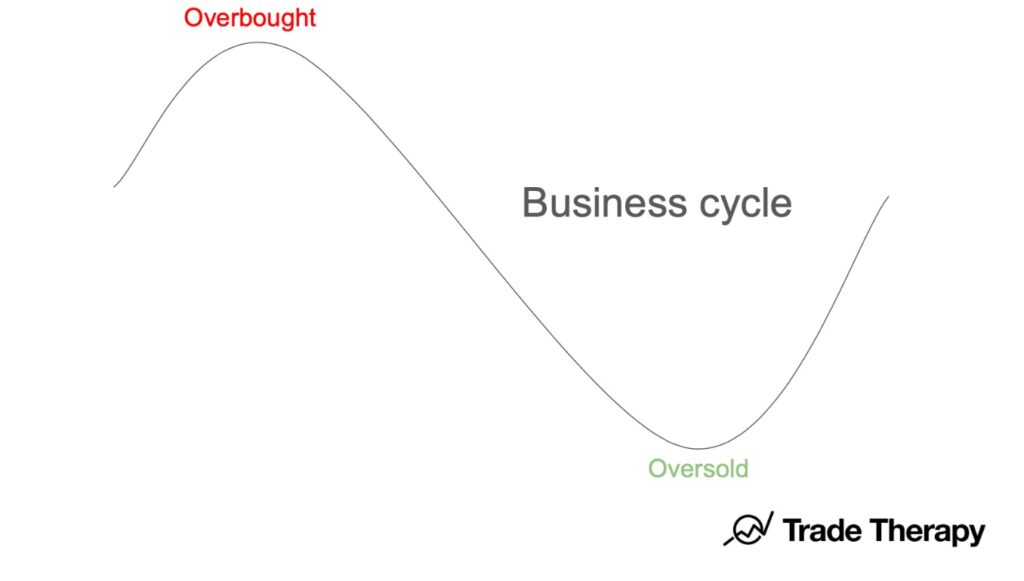
Business cycles are a normal occurrence in a healthy market. Positions are accumulated in oversold conditions and distributed at the conclusion of uptrends during overbought periods. The process creates patterns that are easily identifiable to the trained eye. However, this is also when news cycles will get hectic with either extremely positive headlines at the top or very negative (often creative) news stories at the bottom. It’s at these key moments when your emotions can work against you.

Understanding Institutional Accumulation
Institutions accumulate long positions during oversold conditions that follow corrective periods. Negative news cycles, such as expected recessionary periods, are common during these times as markdown campaigns reach their lows. Wall Street is buying up as much as they can while retail investors are convinced to exit their positions before things get worse. Retail always sells the bottom.
These accumulation phases create tremendous opportunities for those who can recognize the change in trend. Those who cannot get left behind. Trend changes can be one of the most lucrative times to be in the markets, but they can also be confusing. Mixed signals, rapidly changing narratives, and violent price movements often leave retail investors wondering what to do. These are common when monetary policy changes are expected. Wall Street institutions know months in advance and use all their resources to take advantage of the situation.
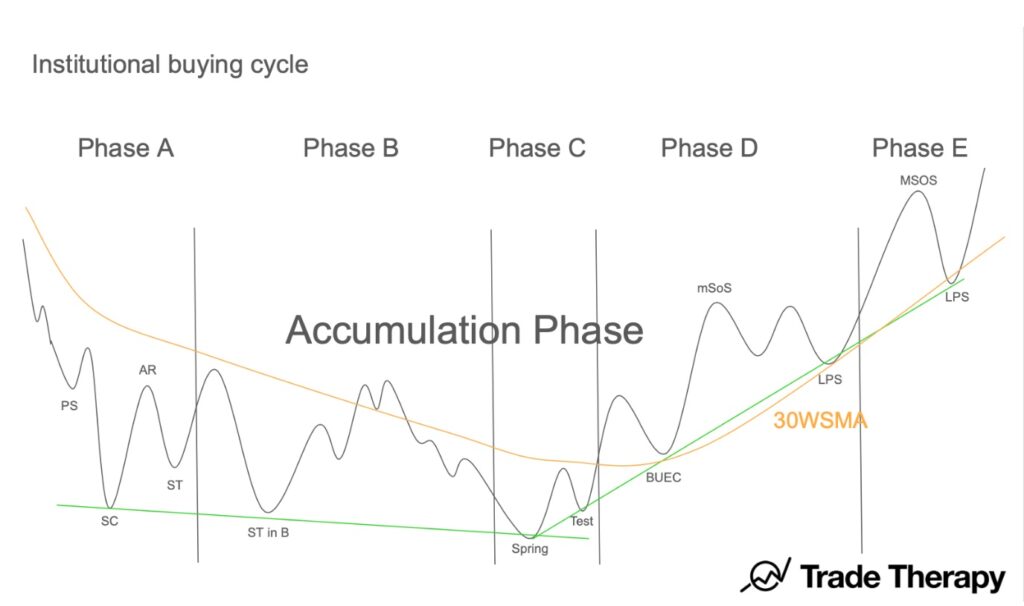
Navigating Institutional Acquisition and Accumulation Patterns
As large operators acquire their positions, they draw in investors who believe they have correctly timed the bottom, only to see the price dramatically reverse, taking out their stops or scaring them into selling. Often timed with negative news cycles, these retracements create ‘sign posts’ associated with specific events throughout the process. These events are based on the groundbreaking work of Richard Demille Wyckoff. Recommended readings can be found in the library. Recognizing these occurrences allows savvy investors to time their entries to align with institutional money flows. Notice the green lines connecting the lows.
Accumulation patterns form in various shapes and sizes but generally create a cup pattern. It’s important to look out for these patterns in market sectors hurt by the previous environment, particularly stocks that have recently set new lows after long, deep pullbacks. These pullbacks are typically associated with recessionary events such as 9-11, the Great Financial Crisis, or the post-COVID inflationary market of today. Previously beloved ‘Wall Street darlings’ are sold off as their future earnings potential is reassessed, costing shareholders 50-85% of their value. It’s perfectly normal but not something you want to be on the wrong side of.

How is that affecting things?
It’s always about money.
Interest Rates, the US Dollar, and Yield Curve Dynamics
When interest rates rise, the US dollar also strengthens. This can lead to an inverted yield curve, a condition where short-term money (bonds or loans for 1-3 years) is valued higher than long-term money (10-30 years). This situation, which never lasts long, implies that future revenues are worth less than today’s. Companies expected to outperform in future revenues see their valuations slashed dramatically today. During a rising rate environment, their stock prices plummet. These periods typically follow long, extended price movements in the opposite direction, similar to the COVID market run of 2020-2021.
What does all of this mean? It means Wall Street has once again unloaded their positions onto retail investors at the top. Their long positions are converted into short positions as they take profits from the previous run. Changes to monetary policy often occur during these periods. Remember when the Federal Reserve changed their stance on the ‘transitory’ nature of post-COVID inflation in November 2021? Rising interest rates, or the expectation of them, puts downward pressure on ‘risk’ assets (growth, biopharmaceuticals, emerging markets, small caps, etc.). These assets are considered higher risk due to their size, age, location, or industry and are prone to violent price movements in both directions—Wall Street loves them.
Eventually, interest rates will fall, and the hysteria of the post-COVID markets will be over. Good economic news, which we’ve been told is bad for the past few years, will become good again, and these assets’ valuations should skyrocket. This is a business cycle, and it’s essential for everyone to understand. It’s how Wall Street makes money. Align yourself with them, and you’ll be alright.

US Dollar ETF (DXY) and Its Impact on Market Sectors
This is the all time monthly view of the US Dollar ETF (DXY). Generally, the US Dollar moves inversely to higher risk sectors of the markets. When you see a topping pattern, such as the one that appears to be occurring now, it’s time to look closely at interest rate sensitive areas of the market. Why? These peaks in the price structure (above chart) are associated with changes in monetary policy. This is when periods of rising interest rates end and rate cuts begin. When interest rates get cut, the future value of money goes up. When the future value of money goes up, companies that are expected to earn much larger revenues in the future (growth companies) see their valuations skyrocket. Having a good sense for where DXY is in its overall cycle is a fundamental first step in understanding what larger interests will be looking for over the next few years.
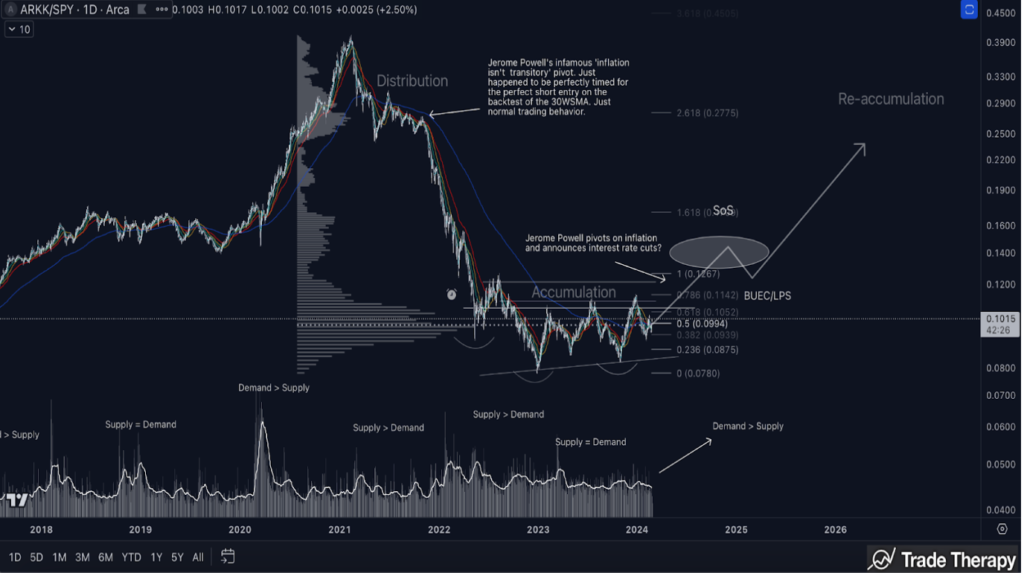
If we assume we’ve correctly identified a change of trend in the $, it should start to show up in risk related charts. We rely on a ratio chart that shows strength or weakness between two assets. In this example (below), we’re reviewing the weekly chart for ARKK/SPY. ARKK is Cathie Wood’s flagship fund and one that is entirely dedicated to ‘innovation’ (growth). SPY is the S&P 500. This helps to understand rotation out of the larger, mega cap companies into smaller, growth oriented companies. Risk assets do well during easing monetary policy periods. When interest rates drop, risk assets outperform and it’s no surprise to see an extended, institutional accumulation pattern currently present.
Navigating News Cycles and Growth Stocks
Individual growth stocks have also gone through long, extended accumulation phases. During these periods, it’s common for news cycles to become very negative, emphasizing ‘possibly’ very bad outcomes in the market. Since COVID, we’ve been told that good economic data is actually really bad, prompting advice to sell your growth portfolio. Headlines warn of China invading Taiwan or another Financial Crisis because regional banks are failing.
The news is always bad at the bottom. Wall Street is trying to accumulate as many interest rate-sensitive assets as possible, using their extensive resources to promote certain data points as newsworthy. This is one of the key reasons why listening to the news, as it relates to the markets, is a bad idea. Stick to the charts and follow the money.
What can we work with?
Change is good.
Understanding Trend Changes and Market Dynamics
Trend change produces some big swings in price behavior as larger operator’s have filled their inventories and are ready to begin the mark up phase. It’s also when demand becomes greater than supply. There are multiple entries using either Moving Averages (MA) or Fibonacci levels to trade the new uptrend as demand > supply conditions take hold. These patterns form as the late stages (Phase C & D) of accumulation transitions into Phase E. Generally, the lows of this ascending triangle pattern (see chart insert) are good risk/reward entries.
As larger interests rotate from short to long positions, the relationship between supply and demand changes. Supply > demand conditions are created throughout a correction or downtrend. There are more sellers than buyers present and price must drop to find equilibrium. During the accumulation period, supply equals demand as institutions convince retail investors to sell their positions at the bottom. Once this rotation is complete, Wall Street is now long, mark up will begin and moving averages will be retaken. Demand becomes greater than supply and prices must rise until equilibrium is once again established.
As previously mentioned, headlines should be expected to be very bad at the bottom. Always keep in mind, the media is a tool that is utilized by Wall Street institutions to elicit emotional responses from retail investors. The media is not there to give you financial advice. Stick to the charts and the data. Numbers don’t lie.
Here are a couple recent examples of the types of accumulation processes currently occurring. Members of our weekly Clarity service receive these types of individual chart details keeping them more up to date on what is happening in the various sectors/stocks/ETFs covered by Trade Therapy. Detailed explanations of all of the indicators are provided helping members to gain a deeper understanding of the supply vs. demand dynamic. As in all of our charts, future price levels are used as examples and should not be considered time sensitive. These are intended to be illustrative of the next phase(s) of the cycle only.
RIVN
Big moves for RIVN in March as it transitioned into Phase C in Wyckoff terms after missing their earnings number by .011 cents. They posted revenues of $1.4B but the narrative quickly became are they ‘going out of business’. This somehow justified a +40% sell off. Notice how high the volume (bars at the bottom) have been since June 2023. This indicates institutional activity. Retail investors don’t generate these volumes. Also, notice how many more larger white bars there are compared to dark gray bars. This is large amounts of RIVN being accumulated.

Bullish scenario: Buyers step in here and take control setting this final low (Wyckoff Spring). Uptrend should develop from here though backtests should be expected.
Bearish scenario: Sellers continue to provide supply putting more downward pressure causing any backtest to fail.
Keep in mind, RIVN will still be under accumulation until it clears this accumulation range. Large operators will employ all of their tactics to acquire as many shares as possible. Sharp pullbacks from wave 1 to wave 2 is one of their favorite methods of flushing out newly entered positions. This takes out stop losses making those shares available which are quickly bought. When considering entering one of these accumulation phases, keep a long range focus in mind. If it pulls back and even sets a new low, that doesn’t change the overall analysis. It will still most likely be under heavy accumulation. Be patient and understand what the larger players are trying to accomplish.
ZM
During Covid there was a narrative created that ‘‘Corporate America’ uses Microsoft Team’s. As soon as we go back to work, ZM will sell off and not be worth as much as it is now.’ Oddly, that coincided with a mark down process that was aligned to the rising $USD discussed above. They just reported their largest quarter ever for the third time in the last four. They’ve more than doubled since Covid.
Notice the surge in volume as earnings were released Feb 27. This move indicates this is likely an impulsive structure based on Elliott Wave Theory (EWT). The ABC corrective wave structure (downtrend beginning Oct. ‘20) has likely completed and we’re now heading into wave 3 of the first breakout structure of the new bull market trend. These types of setups are what trend change opportunities are all about.
It should not be surprising that we’ve seen a long, slowly developing accumulation phase as Wall Street wants as much of this as they can get. They know interest rates are about to be cut. ZM is squarely in the middle of the sector that will most be affected by a change in interest rates. Growth. It’s extremely rate sensitive.
This is a great example of the added benefit of EWT when applied with Wyckoff. Notice the red (C) below the current low (Spring). That looks like the end of the downtrend or wave 5.5. This should be validated by the wave count of the new structure as it forms. The smaller red (c) appears to be the bottom of wave 2 of this new bull trend.

Here’s the upthrust after earnings (below). This gives the appearance of confirming the low is in. We’ll see how this plays out over the coming weeks/months. Again, sharp backtests and sudden pullbacks near the previous low of $58.87 are to be expected. This is all part of the process of supply vs. demand playing out as the downtrend converts from supply > demand to a new uptrend and demand > supply.

Bullish scenario: Price will breakout of this downtrend (suppy) line and convert it into support by backtesting it. It will then go on to higher fibonacci extension levels as it begins it’s new mark up campaign (uptrend).
Bearish scenario: The corrective wave structure is not completed and price rejects this downtrend line as supply returns. Large operators love to extend downward structures right at the end to extract every last seller. This is part of how they create a path of least resistance removing anyone that might sell into them taking profits as they move price up.
Next month: The China Trade
Disclaimer: Any of the content produced by Trade Therapy, L.L.C. is intended for US recipients only and is not directed at or intended to be relied upon by UK recipients. Any information or analysis in Trade Therapy, L.L.C. content is not an offer or the solicitation of an offer to buy any security. Nothing in any of our content is intended to be investment advice and should complement thorough due diligence as one of various sources. Any opinions, analyses, or probabilities discussed in any Trade Therapy, L.L.C. content are those of the author as of time of publication and are subject to change without notice. It is possible some of the employees and affiliates of Companies referenced in Trade Therapy, L.L.C. content may be customers of Trade Therapy, L.L.C. Our goal is to be transparent and independent and we do not believe any of the material present in any of our content is a material potential conflict of interest or impacts the content of our research in any way. All content produced by Trade Therapy, L.L.C. should be considered for education purposes.
Leave a Comment
You must be logged in to post a comment.