

What’s goin’ on?
It seems like things are going better. Then, we seem to take a giant step back.
Market Dynamics and Accumulation Tactics
After seeing buyers stepping in throughout March as breadth began to look stronger, April has seen sellers returning. The latter stages of accumulation phases are often characterized by significant backtesting. Large operators are still accumulating to fill their inventories while prices are low. What appears to be a breakout can quickly revert to backtest the previous low.
One of their favorite tactics is to suddenly drop the price back into the range of the previous or local low, triggering all the stop losses for traders who believed they correctly timed the bottom. This allows them to acquire more shares and remove the ‘weaker’ holders who are more likely to take profits as prices begin to rise. It’s more expensive for Wall Street to absorb sellers on the way up. Taking them out of the equation early and often helps them maximize efficiency throughout the trading process of the overall business cycle.
Navigating Market Turmoil and Institutional Strategies
It’s not uncommon for there to be significant turmoil in the news during these periods. Existing market conditions are still perceived as vulnerable to any bad news, as a long line of negative headlines initially pushed the markets into corrective cycles. Whether it’s the potential impact of escalation in the Middle East, high inflation numbers, or another geopolitical issue, there always seems to be something that sounds very alarming and could suggest the market will continue to decline. The combination of sharp backtests with negative headlines has proven to be a very effective strategy.
In April, we’ve seen this process playing out across multiple sectors as interest rate-sensitive areas of the markets establish their bottoming (accumulation) structures. There are many speculative ideas regarding when interest rates will come down. The truth is, it doesn’t matter when rates will come down. All that matters is when institutions will stop accumulating.
A look at the bond market shows us that big changes are expected, as shorter-term bonds have developed topping patterns while longer durations have developed bottoming patterns. This occurs because Wall Street institutions already know when these policy changes are expected and have established their positions. When they’re ready to begin moving prices up, suddenly, we’ll see interest rates change. More on that in a bit.
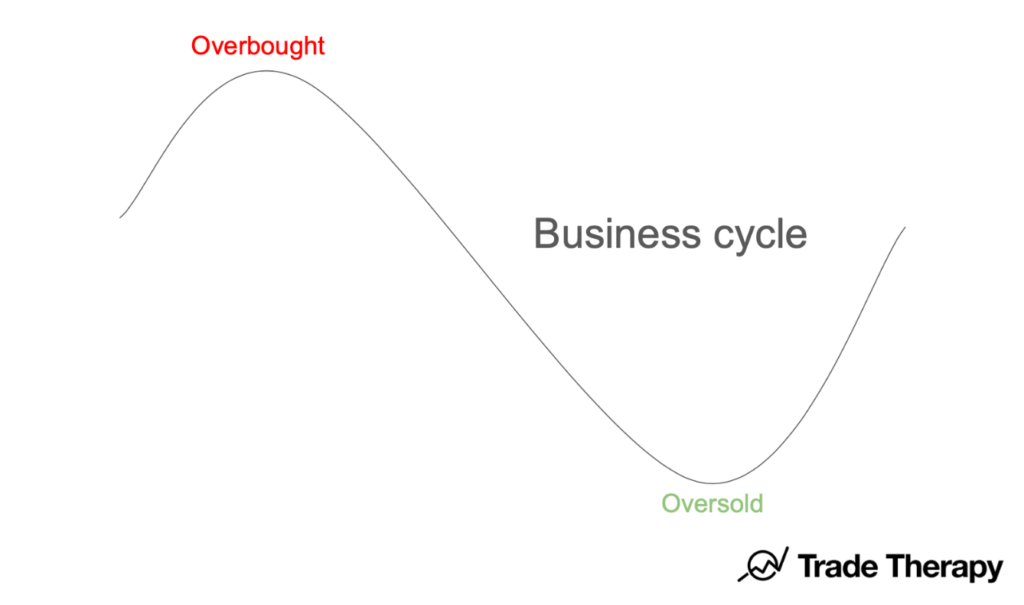
It’s time to begin formulating your strategy for what’s to come as the business cycle changes from oversold conditions to markup campaigns. This change occurs as institutions begin to provide more demand, drawing attention to the asset as prices begin to move up. There are a number of ways to do this, including overloading the order book, utilizing derivatives, changing the media narrative, and more. All resources will be exhausted in the process of moving the price higher. What’s important is to identify the accumulation pattern, position yourself alongside the institutions (buy when they buy), and let them do the work.
Here’s an example of what this process looks like. In September 2022, Nvidia (NVDA) bottomed out with a Wyckoff Spring structure, detailed below. This durable low marks the end of the markdown campaign designed to apply downward pressure as institutions acquire it on sale. They do this by changing the supply vs. demand equation by dumping supply on the market. Detailed here in June 2022, identifying the falling peaks (lower highs), the supply range, and the most likely demand range where Wall Street will retake their positions. Notice the rise in dark gray volume bars at the bottom of the screen indicating massive supply. Apologies for the fuzzy charts—they weren’t intended for publication at the time.

Here’s the update from September as the low is established and volume spikes indicating institutional accumulation. Retail investors don’t generate this kind of volume. During this period, the news was full of inflationary nightmares and expectations of recession. Meanwhile, Nvidia was putting in a bottom averaging over 250M share trading hands per week.
After briefly visiting the previously identified demand range ($115-$135), Nvidia went on an historic bull run and is still currently trading over $875. Notice the accumulation structure it formed and the ‘sign posts’ left behind through the process.
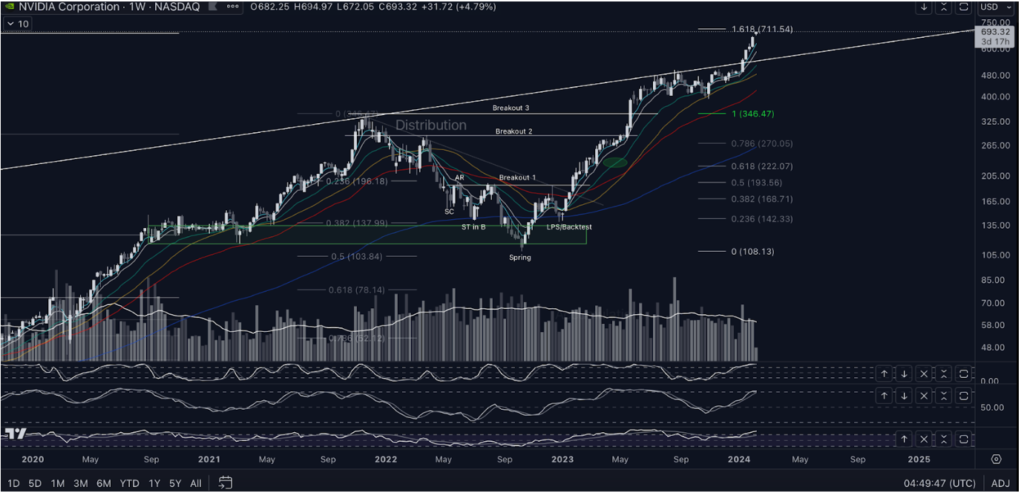
See if you can identify the different phases and the different labels below.

How is that affecting things?
It’s been a mixed bag. Some days are good, some, not so good.
April Market Pullback and Signs of Trend Change
Although April has seen a pullback in the indexes and most individual stocks, the process of trend change continues, and signs of change are everywhere. While we still haven’t seen any changes to monetary policy, the threat of possible change looms, leading to volatility. Until there is clarification from the Federal Reserve, speculation will continue, and dramatic price swings should be expected. All of this creates the perfect conditions for Wall Street institutions to carry out their backtesting tactics (see Tesla example below).
In March, we discussed the value of the US dollar and the impact of interest rates. Higher rates raise the value or perceived value of shorter-term debt, as they pay higher interest rates. Longer-term debt most likely hasn’t been refinanced and is at much lower rates. This inverts the ‘yield curve,’ showing that short-term dollars are worth more than long-term dollars. This drives down the value of future revenues, thus discounting high-growth companies. These conditions will remain until short-term bond yields come down and long-term bond yields go up, reverting the yield curve back to ‘healthy’ levels, and future revenues become prized once again.
One way to track this process is by looking at longer-term bonds for a bottoming process similar to the accumulation process detailed above. If prices of longer-term bonds are expected to increase (as they will when interest rates drop), institutions will be buying them, and we know what structure to look out for.

Institutional Accumulation in 20+ Year Treasury Bond ETF (TLT)
Not surprisingly, we see the familiar institutional accumulation structure in the 20+ Year Treasury Bond ETF (TLT). One look at the volume at the bottom of the chart tells you all you need to know. Retail investors don’t generate this kind of volume—this is clearly Wall Street institutions acquiring massive positions at the bottom.
Notice the news headlines identified at the top and how the Fed’s pivot from “inflation is transitory” to “inflation is not transitory” occurs at the perfect short entry within the chart (testing and holding the 30-week simple moving average (30WSMA)). Coincidence? Possibly. It really doesn’t matter as long as investors know what to look for and can recognize what the data is telling us. In this case, the day after Thanksgiving 2021, it was not a good time to be holding long positions.
Anticipating Institutional Moves
Now that the accumulation process is well underway, don’t be surprised if we see a similar pivot occur at the ideal long entry point. Our speculative forward path reflects the setup as we move toward easing financial conditions. Expect to see a similar announcement somewhere near the backtest of the 30WSMA.
USD and Emerging Markets Dynamics
As discussed, the USD is closely tied to interest rates, and as rates have risen, so has the USD. What most don’t realize is that as the value of the USD increases, emerging markets suffer. It’s an interesting subject to research and, once understood, can work to an individual investor’s advantage.
It isn’t a coincidence that as interest rates spiked, so did negative headlines directed at China. Though the second largest economy in the world, China is still considered an emerging market. As the USD has risen in value, Chinese assets have experienced a massive selloff. It’s very common during these markdown periods for negative sentiment to be fueled by analyst downgrades and commentary from Wall Street institutions. For instance, JP Morgan announced in April 2022 that Chinese internet stocks were “uninvestable.” This became the accepted narrative for all China stocks.

Example: FXI (China Large Cap ETF)
This is the China Large Cap ETF (FXI). Notice the large volume spikes as the price extends below the volume profile (white horizontal bars extending from the left). The volume profile indicates how many shares were traded at those price levels during the time frame extending to the right of the profile. There’s liquidity below the volume profile, and as the price dropped below it, large volume spikes appeared. What does all this mean? It means institutional money bought a significant amount at the bottom. JP Morgan admitted it was a mistake to label Chinese internet stocks ‘uninvestable’ in April 2024, just after the last dip below the volume profile and the large volume spikes. In fact, there’s been ‘historic’ money flow from hedge funds into China since January 2024.
Beginning to see how the media is a very useful tool for Wall Street? As interest rates spike, negative headlines fill the airwaves while institutional money flows in. It won’t take long for the narrative to change, and suddenly demand will come pouring in. Excessive supply brings the price down where institutions fill their inventories. Excessive demand pushes prices up, drawing the attention of retail investors. Fear of missing out (FOMO) is a real thing.
What can we work with?
Change requires a different approach.
Adapting to Market Changes
As we discussed in March, trend changes bring tremendous opportunities, and emerging markets are no different. It’s important to note that generally, politics and investing don’t mix, although politicians seem to make great investors. It’s not easy to put aside personal feelings to take advantage of a trade, but it’s essential. This is similar to not listening to the news and focusing on the data within the charts. Significant catastrophic events can impact certain sectors of the market in the short term, but it’s the ongoing stories that last months and years we’re referring to.
As with any charts we share, we aren’t recommending these trades and are solely using them as examples of trend change and how to identify institutional accumulation. However, there are some tremendous setups coming out of the China sector.
Legends like Warren Buffett are known for classic quotes such as “buy when there’s blood in the streets” or “be fearful when others are greedy and greedy when others are fearful.” These principles align with the tactics we’ve discussed about how large institutions accumulate their assets. They create ‘blood in the streets’ with dramatic headlines and erratic price behavior. Never forget, Wall Street’s main goal is to convince retail investors to sell at the bottom and buy at the top. This is how it’s done.
Current Accumulation Examples
Here are a couple of recent examples of the types of accumulation processes currently occurring. Members of our weekly Clarity service receive these types of individual chart details, keeping them more up to date on what is happening in the various sectors, stocks, and ETFs covered by Trade Therapy. Detailed explanations of all the indicators are provided to help members gain a deeper understanding of the supply vs. demand dynamic. As in all our charts, future price levels are used as examples and should not be considered time-sensitive. These are intended to be illustrative of the next phase(s) of the cycle only.
FUTU
Futu has been referred to as the ‘Robinhood’ of China. It’s based in Hong Kong and does most of it’s business internationally. After a relatively brief accumulation period after it’s initial public offering in March ‘19, Futu went on a meteoric run going from $8.16 to $204.25 in less than a year. After distributing and marking down, it has gone through an extensive accumulation period in a classic symmetrical triangle pattern for well over two years now.
Throughout the process of accumulation, there have been several ‘bear attacks’ expertly timed to some negative headlines that broke overnight pushing price action down only to see buyers step in to support. Steady accumulation has taken place as ‘rising valleys’ have formed. It’s important to note the symmetrical triangle pattern can be unpredictable as it’s been known to break either way. This is where a weight of evidence approach is critical as is discussed in detail for Clarity members.

This is the all time weekly chart. Notice the extensions below and above the trendlines that lead to strong price movements in the opposite direction. These are referred to as false breakdowns or false breakouts and are one of Wall Street’s favorite tactics. We’ll be discussing them in much more detail next month. These trend lines are either demand (at the bottom) or supply (top). Retail traders use them to place their stops either slightly above or below as price has historically respected these trendlines. In an effort to generate liquidity (buy more or sell more), operators will create these false moves to trigger stops in a last ditch effort to take out as many of the ‘weaker’ hands as possible. This is also part of creating a ‘path of least resistance’.
Bullish scenario: Buyers step in as volume surges pushing price past the local high of $72.20 from Dec. ‘22 and converting this level to support by backtesting it
Bearish scenario: Supply comes in pushing price below the $35.91 low from May ‘23. This would form a corrective ABC wave structure beginning at the Dec ‘22 high and possibly testing the low of $28 from Oct ‘22.
NIO
Similar to FUTU, NIO went on a massive run from a low of $1.19 in Oct ‘19 to an all time high of $66.99 in Jan ‘21. Yes, that’s roughly a 5600% move in a little over a year. Distribution began in Jan ‘21 and lasted until a selling climax formed in Oct ‘22. Throughout most of ‘22 a redistribution pattern formed as institutions lured in retail investors with sudden upward thrusting price behavior. Another one of Wall Street’s favorite tactics, this upthrusting price action in redistribution periods leads investors to believe they’ve perfectly timed the dip. Fear of missing out strikes again as the mark down process continues taking out all the dip buyers.

Barclay’s downgraded NIO on April 2, 2024. This helped to produce two more downward weekly bars. The price dropped from $4.30s to $3.80s leading up to what we’ve labeled the ‘Spring’. This was roughly a 12% drop. The following two weeks saw prices increase 21% on average. Better yet, Goldman Sachs upgraded NIO on October 7, 2021. Price dropped 90% over the following 2.5 years. See how far those white bars extend from the left side of the chart? This is the volume profile. It indicates how many shares traded hands at those levels. This is what retail investors buying the top looks like. Just a little reminder, don’t listen to the news or the financial media or the banks. They aren’t your friends.
NIO is in late stage accumulation. Notice the similar price behavior from March ‘19 to October ‘19 compared to August ‘23 to today. Steep declines late in the accumulation phase is to be expected. Professional money is trying to force everyone out of the trade before changing the dynamic from supply > demand to demand > supply.
Bullish scenario: This is the beginning of a new uptrend as the low (Wyckoff Spring) is in. Expect a backtest before continuation to the upside. Watch for volume to come in and for the narrative to change.
Bearish scenario: A failed backtest leads to a lower low.
Disclaimer: Any of the content produced by Trade Therapy, L.L.C. is intended for US recipients only and is not directed at or intended to be relied upon by UK recipients. Any information or analysis in Trade Therapy, L.L.C. content is not an offer or the solicitation of an offer to buy any security. Nothing in any of our content is intended to be investment advice and should complement thorough due diligence as one of various sources. Any opinions, analyses, or probabilities discussed in any Trade Therapy, L.L.C. content are those of the author as of time of publication and are subject to change without notice. It is possible some of the employees and affiliates of Companies referenced in Trade Therapy, L.L.C. content may be customers of Trade Therapy, L.L.C. Our goal is to be transparent and independent and we do not believe any of the material present in any of our content is a material potential conflict of interest or impacts the content of our research in any way. All content produced by Trade Therapy, L.L.C. should be considered for education purposes.
Leave a Comment
You must be logged in to post a comment.